Tuesday, June 5, 2012

Day 7 - Kids and Cats


Tuesday June 05 2012

I saw the sun today!  Which was good, because I checked off some of the last housing projects that I wanted to see.  I did a lot of tram-riding today, first heading to see H.P. Berlage's Plan Zuid (South), where he saved the keystone tower and surrounding wings for himself to design.  It was uncanny, very stoic, great brickwork but restricted.  There was even a funny statue of Berlage at the end of the road. 


Then I headed north through the Nieuwe Pijp neighborhood, where there were several schools with so many children running around.  My target site was De Dageraad, another work by M. de Klerk and fellow Amsterdam School architects.  I am not sure the year it was constructed, but I would venture to guess either right before or right after Het Schip, due to similar elements of design.  There are some great details here too.  However, I don't really like kids especially around the ages of 12-16 so I didn't stick around there too long.  Took the tram back to Centraal Station where I got a cheese sandwich on raisin croissant type bread, and also spontaneously decided to try a bag of Dutch liquorish.  Well that was a big surprise, because it actually tastes salty, in a strange way, imagine saltwater taffy but less sweet and more licorice.  Just plain weird, I don't know if I like it, but I can't stop eating them. 


After my bizarre lunch, I took the tram out to IJBurg, another artificially constructed island with entirely contemporary architecture - housing/residential mostly, but also schools, and offices primarily.  Remember what I said about being wary of children?  Well, it seemed like IJBurg was infested with them.  I suppose I was visiting right as school was being released, since I saw more kids on bikes than anything else.  And let me reiterate, as dangerous as adults are on bikes, that level approximately quadruples when the biker is a child.  I witnessed no less than three full-on bike accidents involving small children.  I'm talking 5 - 9 year olds.  And there were no other adults in sight!  Most of these accidents did not happen right in front of me, otherwise I'd feel the need to help, but even still, I'd probably scare the poor crying thing with my lack of language.  Ugh.  I guess that's just the Dutch way, though, no handholding, just learn by experience.  


The only thing IJBurglaand had more of than children was cats.  They were everywhere.  I'm assuming they had owners because they were pretty nice looking.  It reminded me of Borneo Sporenburg and KNSM.  However, IJBurglaand has a much more metropolis feel in the center than Borneo.  In terms of architecture, however, there is such a high density of good works within such a small area.  That's the Dutch mentality, though - maximize with sensibility.  It's almost unreal.  Anyway, I wandered the whole island and was beyond impressed.  Well, tomorrow is my last full day here, and I have plans to fill it up!


Monday, June 4, 2012

Day 6


Monday June 04 2012


Today I took a day off from my main architecture research for a couple of reasons: one - it was raining again, and two - there were a few things that you absolutely must do in Amsterdam and I hadn't done them yet.  The main one is to visit the Anne Frank house museum, in the western canal district.  Before that, however, I stopped at the FOAM photography museum that is very close to my hotel on Keizergracht.  Free entry with my museumkaart, and it was a cool little building with a warehouse-esque interior.  Then I trekked up to the Anne Frank house, and had to wait in a line in a sea of umbrellas for about an hour.  It wasn't too terrible, though toward the end it was getting quite chilly.  I made friends with an older couple who had come from Minnesota.  We chatted and commiserated for awhile.  When I got into the museum (free with my museumkaart) it was quite the experience.  You'd have to be inhuman not to feel some strong emotions when you go through the progression of rooms and the secret annex where Anne and her family hid after fleeing from Germany, while along the way the story is being retold.  And for those who know how the story goes, it does not have a very happy ending.  Their hiding place was betrayed and they were arrested, sent to Auschwitz, where only Otto, the father survived.  


After that sobering experience, and exiting back into the rain, I needed a place to warm up inside and out.  I continued up Prinsegracht and faced my fear of entering into restaurants by myself to enter: The Pancake Bakery.  It's one of Amsterdam's most renowned pannekokenhuis (pancake house).  I was quickly seated (solo) and served.  They do have savory options such as ham, cheese, onion, etc. but I ordered the most delicious looking thing on the menu: a café latte and a dutch apple pancake with cinnamon ice cream and whipped cream.  Let me explain.  The pancake is as big as your place, and it is a different consistency than American pancakes, which are lighter and fluffier with less substance.  The ice cream was delicious and the cold was a perfect contrast with the warm pancake.  The whipped cream was delicious as were the tart slices of apple.  I was starving initially and thought I would scarf it down in no time, but toward the end I was having trouble finishing!  I did though.  It was well worth the 16 euro I spent.  Instead of mints with your check, they put little hopje candies, which taste a little like coffee but have no coffee or caffeine ingredients.


After regaining vigor and a full belly, I decided to make a stop at the Amsterdam History Museum.  It was a detour I was glad to have taken, as I learned a lot about the transformation of the city over time.  In addition, they had a special temporary exhibit about the trade relation between Istanbul and Amsterdam, as this year marks a historic anniversary.  Very interesting, as my thesis was situated in Istanbul...full circle.


On my walk back to the apartment, I stopped at the Bloemenmarket on the floating Singel.  So many flowers!  I also went into some Dutch cheese shops and sampled some delicious cheese from Holland.  


I'm going to go get some quick dinner now, but tomorrow is supposed to be not rainy (hypothetically) so I want to get an early start as there are still a lot of pictures I want to take of buildings.

Sunday, June 3, 2012

Day 5


Sunday June 03, 2012


Rainy day again.  I am finding that it is true that there is often a gray sky across the Netherlands, maybe another reason why dwellings are built to maximize the amount of possible daylight.  I thought it would be nice to rest my feet today and not go anywhere far, but decided to head back to the Van Gogh Museum and the Stedjelik museum.  Turns out that the Stedjelik museum is closed for renovation until September 23!  That's too bad.  But I did get to see more of the Van Gogh museum, and what was a nice surprise, the extension which housed a great exhibit about Dreams of Nature, particularly Symbolism in landscape paintings, a style that acted as a backlash against the reductivism of modernity.  The exhibit text explained it well:

"Symbolism was an important movement in European art between 1880 and 1914.  In many ways it was a reaction to the modernity of the period - notable industrialization and urbanization - and to the realism of contemporary paintings and novels.  The Symbolists, by contrast, were more interested in suggesting than in describing reality.  Their aim was not to produce a superficial likeness, but to evoke inner meanings, to conjure up moods and dream states. 
Symbolism drew inspiration from various sources in science, music, and literature.  Among these were the ideas of the French poet Charles Baudelaire about the interconnectedness of the senses (correspondances), and the music of the German composer Richard Wagner, who fused different art forms to produce a comprehensive work of art (Gesamtkunstwerk).  There was no fixed style of symbolist painting, however.
Landscape was an ideal subject for symbolist painters.  It provided universally recognizable motifs with particular association: twilight evokes peacefulness and calm, for example, and the sea conjures up visions of infinity.  Artists used their various styles to suggest moods, strange worlds, and spiritual enlightenment."

What I find somewhat off-balance is the differentiation between suggesting and describing in the Dutch tradition.  It is clear that these differ.  Martin Jay classifies one of his scopic regimes of modernity as the "Dutch art of describing."  However, Piet Mondrian, a Dutch De Stijl painter during the period of Modernity, was one of these Symbolist painters (in his early works - Windmill/Sea After Sunset).  Mondrian wrote in a letter to H.P. Bremmer dated 29 January 1914, "Nature (or that which I see) inspires me, provides me - as it does every painter - with the emotion by which I am moved to create something, but I want to approach the truth as closely as possible, abstracting everything until I come close to the foundation - still only an outward foundation! - of things."  This quote sums up the tension between the emotion/empirical and the reason/rational that collide often in Dutch art and architecture.  Here, Mondrian was not purely suggesting what could be, but rather describing in novel ways (leading to abstraction) that incorporated emotion.  His later abstract work which corresponds with the De Stijl movement (Rietveld, et. al.) on the other hand, perhaps lacks the direct emotional element, but retains all the rest.  Jay (p. 10-15) was referring to early (Golden Age) Dutch art, particularly Vermeer and the "disincarnated" gaze which is a second order perspectivalism with the first being Cartesian, with influences in Italian Renaissance art.  It is highly ironic then, that there saw a split in what could be considered Dutch art during this period of modernity, and that Dutch art was no longer merely an art of "describing" at a literal level, but something more.  We can see this in architecture beginning with the Amsterdam School - I would argue that Berlage is less successful than de Klerk, but that can be explained later.  Cuypers is an odd case too, but there is a definite trajectory between him and de Klerk (teacher and pupil).  In any case, I've just started to dig into this phenomena; more research will commence later.

It's hard to tell if Mondrian's paintings fit in with the agendas of the rest.  However, I found some artists to be truly compelling.  There was George Fredric Watts, with "After the deluge: the 41st day" which was supposed to be a telling of Noah's ark, but reminded me of Barnaby Furnas's contemporary "Red Sea" series...basically painting the great flood or the end of the world.  There was Leon Spilliaert's "Royal galleries Ostend" which was a dark Ballardesque scene if I had ever seen one, before Ballard obviously, in 1908.  There was Cazin who paints scenes that register in the hour between light and dark, the feeling of eternity.  And my favorite was August Strindberg, a Swedish painter and scientist who captures perfectly the struggle between the rational and the irrational.

After I explored the museum to its fullest, I decided to get a bite to eat at the café.  I got a slice of quiche, a Dutch strawberry-yogurt drink (don't ask, it was oddly tasty), and this slice of what looked like cheesecake but what turned out to be a very light, almost fluffy custard with deliciousness inside and a somewhat tangy and sweet glaze on top.  I can't even tell you what it was (like most Dutch food), but it was amazing.  I've decided that the Dutch are so bad at making savory meal items (as far as I can tell), that they have to compensate by making extra delicious sweet things.  


After the museum, the rain had slowed a bit so I wandered back to the Vondelpark, the church designed by Cuypers, and the house in which he lived.  The neighborhood was quite, and a completely different character than the other areas of Amsterdam (as they all seem to differ quite a lot).  This area seemed very well-to-do.  Then I walked around the Amsterdam Oud-West to snag some photos of some other contemporary housing projects.  Some very interesting work.  Made it home before my feet gave out.  Turns out my 'not-so-much-walking' strategy did not go as planned.  Oh well!  


Day 4


Saturday June 02, 2012

Day 4

Not knowing how to speak a word of the native language is something new to me.  Nederlands (Dutch) is the primary language here, but nearly everyone in a service position speaks fantastic English.  Even the locals on the street speak some English, and well.  Dutch is also not hard to read and understand, as it is quite similar to roots found in English.  However, to hear it sounds like a strange offshoot of German, but as if they have a wad of gum in their mouth.  Or something like that.  And while I can understand a bit of German, I can't produce or comprehend any Dutch.  It's a bit of a strange scenario, since I am a woman walking around the streets by myself in some very non-touristy (but still safe!) areas, I've had quite a few people come up to me asking, probably, for directions.  I just shrug apologetically and say "sorry, I don't" … and they usually get the idea.  So today I looked up how to say "Sorry, I don't speak Dutch" in Dutch.  The translation is this: "Sorry, ik spreek geen Nederlands."  But I don't even know how to pronounce that.  I had every intention of learning a bit of Dutch before I left, but it was kind of hard to fit that in amongst the craziest semester of my life, including trying to produce a thesis project.

Having said that, I am now appreciating even more my familiarity with Spanish and Italian having visited both Spain and Italy.  At the time I didn’t think I spoke either language very well, but even just simple phrases like "excuse me" or "how much does this cost" or "where is…" were useful to have mastered.  Now the places I visit are not solely populated with American or English tourists.  The typical American tourist will hang out in the brown cafes all day, and I go to visit the social housing museum.  There are also tourists in places like these, but from other European countries.  I met an older couple today from Munich; the man was also an architect interested in the Amsterdam School (a style, not a university) of architecture.


And having said that, I had an incredible visit Het Schip in Spaarndammerbuurt, another district located outside of the main center, northwest of Centraal Station.  I walked all the way there, starting early in the morning, so I could see some other buildings on my way, and also so I could make it to the tour given in English at 11am.  The district was formed in the early 1900s in response to the Woningwet housing act that was passed regulating conditions of working class social housing.  Michele de Klerk designed three blocks of housing in this district, including Het Schip (which means The Ship, because it looks vaguely like a ship) and you can see how his style progresses over time, gradually getting bolder and more expressive.  I spent the entire morning here and enjoyed the sun which was great for taking pictures.  With the tour we even got to see inside one of the model apartments.  The rest of the units are still used today for social housing.  Apparently the waiting list is quite long. 


Saturday is a different beast in Amsterdam than any other day of the week thus far.  The streets that are usually bustling are now jam packed with people, natives and tourists on foot and on bike.  This is usually contained to the main squares and streets, so on my walk back to the hotel I tried to take some side-road detours.  The life is so vibrant here, though, and there's always something going on everywhere you turn.  I passed through two different music performances just on my walk back to the hotel.  
 
I had to take a quick rest after my trip to the Spaarndammerbuurt, but after checking the weather for the rest of the week, I realized that there is a possibility that it may be cloudy/rainy for the rest of my days here.  That meant that I wanted to get some good pictures in the sun of Borneo Sporenburg and Java/KNSM Islands.  These comprise the eastern docklands of Amsterdam, entirely artificial constructed islands that are mostly housing, built in the late 1990s.  The atmosphere there was incredible, very laid back but family oriented; and there were tons of cats and children playing around.  The high density of building remains, but does nothing to hinder the general atmosphere.  In fact, it contributes to it.  Along the water (the IJ) there are rows of houseboats, yes, where people live.  I went around dinner time, so there were these really yummy smells wafting from the open windows, and some families were eating outside on their balconies.  After seeing all I could see of that area, I took the tram back to my hotel area, got some dinner, and then fell right asleep for the night.  Hence the small delay in posting.  Another very efficient day, and one of the nicest days in terms of weather!


Friday, June 1, 2012

Day 3 - Amsterdam West


June 01, 2012

Today I walked to Centraal Station to catch the tram out to the Geuzeveld / Slotermeer / Osdorp regions of Amsterdam, which are primarily residential urban areas.  To sustain me on my trip, I bought a package of zukergusskuchen, these little donut type pastries made with lots of butter.  Like most Dutch sweet things, they were very tasty.  It was about a forty minute tram ride out from the center, but it was quite interesting to get away from the busiest and oldest parts of Amsterdam.  In other cities in both Europe and America, as the radius increases from the urban center the density (population and built area) tends to decrease.  This is not necessarily so in Dutch cities, including Amsterdam.  With such a small ground footprint, the Dutch do all they can to fit as much real-estate in as possible.  While this sounds like the developer logic seen in the US, the difference is that the Dutch have approached this as a design problem, using it as an opportunity, and as such are experienced with designing efficiently and intelligently.  This is the theme specifically of the housing projects that I looked at today.  I set out to see two or three projects in particular, and stumbled across some other really well-designed buildings.  Additionally, even the typical residential buildings that were not designed by a "high-profile" architect had similar sensibilities.  These social housing units do not compare to social housing in the US.  Much of that has to do with governmental imperatives, and what is given priority in design.  Amsterdam, as well as much of the Netherlands, is an artificial landform situated on top of the water.  This coupled with the flatness of the landscape contributes to many imperatives unique to the Dutch eye. 


The first project I went to see was MVRDV's Parkrand (trans. park edge) apartment housing, completed 2007.  Built as a part of the urban renewal of the Geuzeveld-Slotermeer region, the building was intended to provide an iconic quality to the neighborhood while situated to promote the public space.  It's true: there is quite a lot of green space in the area with bike paths and benches, especially with the park behind the units and approaching them from the Dr. Collinjstraat tram stop, as I did.  The building certainly is an icon of the area.  However, the highlight of the building in my opinion, are the void spaces, the in-between holes.  These quite sizable voids correspond  with the recurring theme of the "keyhole" or layered spaces.   This is right out of a Pieter de Hooch painting, only...centuries later.  A note to consider later: is it easier to layer something that has more inherent three-dimensionality (depth), as opposed to a row-house for example, that shows up in de Hooch's paintings?  On another note, one could explain the necessity of the layering and voids due to functionality - primarily to let in an adequate amount of light.  This is another theme of Dutch social housing, and an imperative of the architects MVRDV, as will later be seen in the WoZoCo apartments.  Balconies are important as well, although you don't see them in the central area.


As another replacement for the Geuzeveld region, the Ripperdahof is a U-shaped residential complex.  On the exterior (brick) the surfaces are generally austere and closed off, but the interior (steel) opens up to become more transparent, with views out to the interior courtyard garden, providing access to the apartments and acting as balconies.  Note the windows cleanly framed by wood both on the interior and exterior.  


Continuing with the post-war regeneration is another project in Amsterdam West, the Nieuw Peil designed by Meyer and van Schooten.  Many of these rebuilt projects remain disparate from their context (austere modern architecture juxtaposed with formal/material/visual oddities of contemporary architecture).  The Nieuw Peil also stands out from its context but in a more thoughtful way, making use of concrete with a white granite aggregate, a shade that radiates with lightness opposed to the surrounding dull gray and brown buildings.


After this I made a bit of a trek to the Osdorp area, through which I had to traverse down a busy street surrounded by thick vegetation.  Even in such a rural area, the bike lanes and pedestrian sidewalks still existed, for which I am glad.  Then I arrived back into an urban area, with plazas that reminded me of Endwell (without parking lots).  The next two residential buildings were sited right next to each other, standing in stark but compelling contrast.  Het Waterfort by KOW Architecture is comprised of 130 apartment units, located literally on the Sloter Pond.  When I visited, there was even a man fishing in the pond.  Here the brick fort is framed by the white contour, which transitions into the inner white planes.  Layered keyhole spaces can be found into the interior courtyard, though not as dramatic as some others.  Next door is the Shutterstoren, a tall cylindrical (high-end) aluminum and glass apartment building supported by a comparatively slender concrete base.  Inside are 54 apartments and two luxury penthouses at the top.  This building is somewhat of an anomaly in the area.  As I walked to my next destination I came across a housing complex that reminded me of Le Corbusier's proposed housing in Algiers, which is quite similar to the Smithson's 'streets in the sky' concept implemented (unsuccessfully) at the Robin Hood Gardens. 


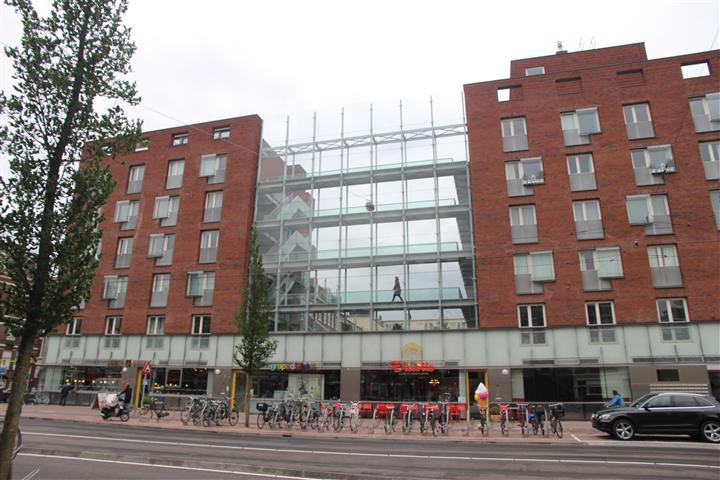
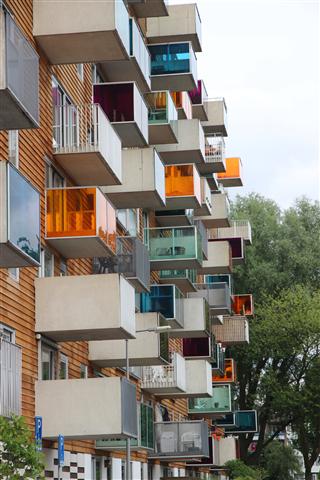
Then, I finally reached the building I had set out for: MVRDV's WoZoCo (Oklahoma) apartments for the elderly.  This was one of the first buildings I did a case study of during my second year first semester during our housing unit.  This initially sparked my interest in Dutch architecture and primarily their approach to housing, so it was quite surreal to be actually get to visit!  The key elements here are the multi-colored balconies, the jutting cantilevered volumes, and the translucent-transparent hall on the elevation facing the main road (a very SANAA-esque move).  The front faces a busy street, but not far past that is a large field and farm with lots of cows. 


At this point, my left ankle was hurting quite a lot from being on my feet all day, so I decided to walk back to a tram stop.  On the way I stopped by two more housing projects, both different than anything I had seen today.  The first was a three block residence, similar to others with its public space in the center, but shorter at only three stories.  This responds to the rest of the buildings in the neighborhood however.  What would be sterile white modern-looking concrete (reminiscent of Portuguese white boxes) is softened by the articulation of wood around the edges.  The residence is sited between two parks, allowing access in between.  The other building is called De Opgang, designed by KCAP as a mixed-use development, with 79 housing units, a church, child care, and parking garage.  This stands out from the other buildings in its slate materiality, but is similar with its inner public courtyard. 


And with that, I caught the tram back and got off at Dam square.  Walked through the Spui and found the American Bookstore, which has a really cool interior.  On my way back to the hotel I walked through the Rembrandtsplein and stopped into a FEBO - where you can get fresh Dutch food from vending machines in the wall.  I know, it sounds weird, but it was pretty cool.  I enjoyed my sandwich thing with an Amstel beer (I say that because I honestly have no idea what it was, or what kind of sauce it had but it was surprisingly delicious nevertheless).  Good productive day!